What Is Iran’s Endgame in the Strait of Hormuz?

What Is Iran’s Endgame in the Strait of Hormuz?
Jul 09, 2026
What Is Iran’s Endgame in the Strait of Hormuz?
Ahmad Hashemi
The U.S.–Iran conflict has flared up again in a familiar cycle of escalation. After Iran targeted commercial shipping in the Strait of Hormuz, the U.S. struck military targets along Iran’s southern coast. Tehran then retaliated by striking the Arab Gulf states hosting those U.S. bases.
While some in Washington might view these rounds of escalation as isolated provocations, Tehran is operating under a calculated strategy.
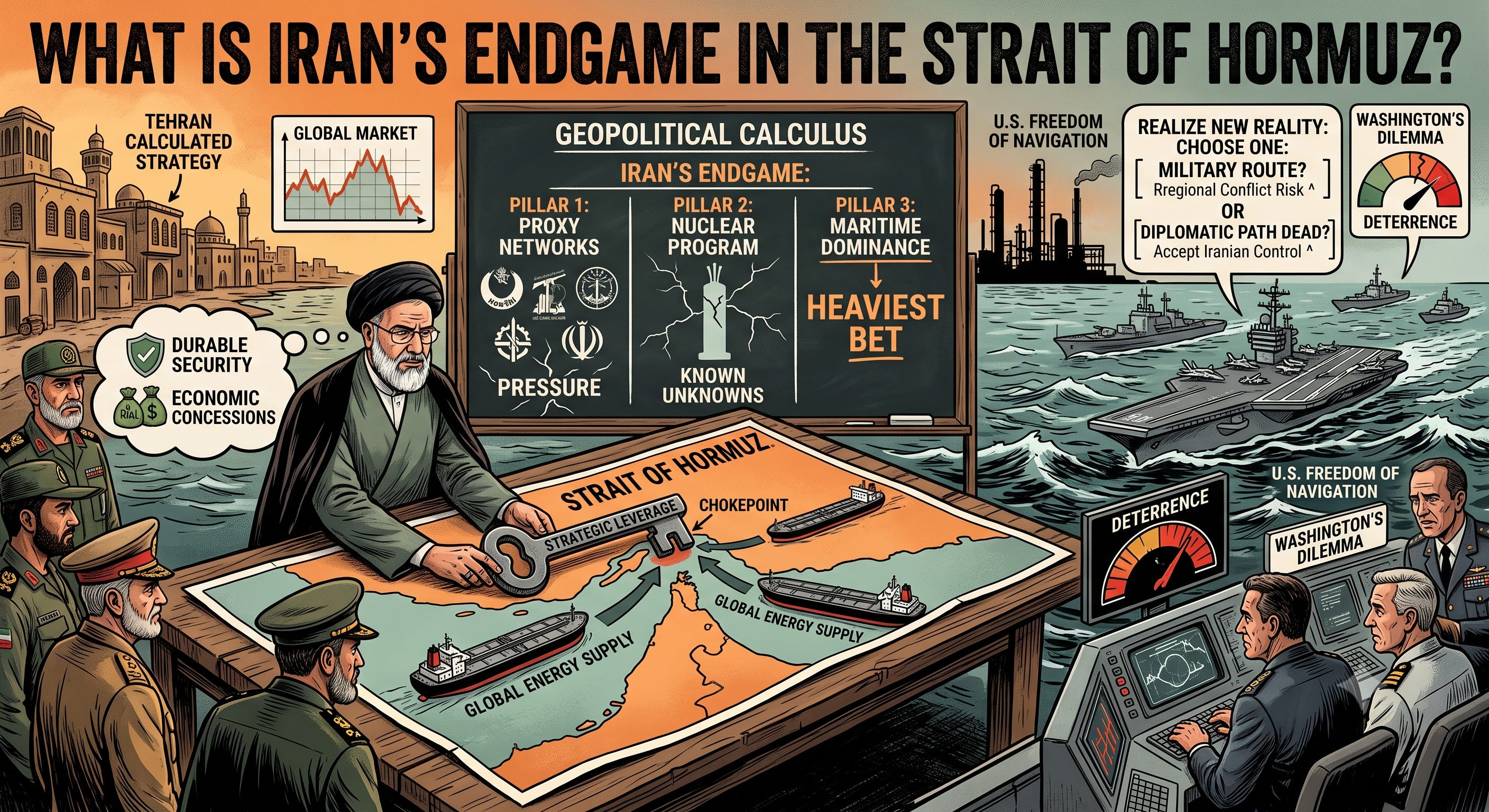
To comprehend Iran’s endgame, one must grasp the anatomy of its leverage. Tehran’s strategic defense during this conflict rests on three pillars: its proxy network, its nuclear program, and its geographic and physical dominance over the world’s most critical energy chokepoint, the Strait of Hormuz.
Following the devastating military conflicts of 2025 and 2026, the first two pillars have faced immense pressure. The declared nuclear facilities suffered severe damage, leaving the program’s status shrouded in a deliberate policy of “known unknowns” and strategic ambiguity. Meanwhile, though its “Axis of Resistance” proxies—including the Houthis and Hezbollah—remain disruptive, direct military clashes have shown that asymmetric tactics cannot fundamentally stop the U.S. from striking back hard.
Consequently, Tehran has placed its heaviest bet on the Strait of Hormuz. Unlike volatile diplomatic agreements or easily targeted military facilities, the Strait provides Iran with an enforceable, physical piece of leverage that binds its own survival directly to the stability of the global economy. By choking the waterway through which a fifth of the world’s petroleum passes, Iran shifts the costs of its containment away from itself and onto global markets.
This fixation on maritime dominance is born from a bitter history of U.S. diplomacy. The Iranian economy remains in dire straits, yet the regime refuses to trade its regional leverage for sanctions relief. From Tehran’s perspective, the Joint Comprehensive Plan of Action (JCPOA) proved that American promises are highly volatile, dependent on renewable presidential waivers, election cycles, and a hostile Congress that can restore economic punishments with the stroke of a pen.
The Iranian regime believes that easily reversible U.S. concessions cannot justify irreversible Iranian sacrifices. Control over the terms of the global energy trade, however, cannot be erased by a future U.S. election. This is why Mohammad Bagher Qalibaf, the Speaker of Iran’s Parliament, recently called the Strait a “divine blessing,” stating that controlling it was Iran’s “greatest means of power.”
Tehran’s immediate strategic objectives in the Strait are both defensive and predatory. On one hand, it serves as a vital deterrent against full-scale foreign intervention—a shield for a regime that lacks a modernized air defense system. On the other hand, it functions as an aggressive bargaining chip to squeeze economic concessions (such as sanctions relief) from an American administration highly sensitive to domestic fuel prices and upcoming midterm elections. Furthermore, it offers a venue for potential revenue extraction via arbitrary “environmental protection fees,” “service fees,” or “transit fees” on passing tankers, while driving a wedge between the Gulf States. By punishing neighbors like the United Arab Emirates for aligning too closely with Israel while preserving a pragmatic détente with a more cautious Saudi Arabia, Iran exploits the strategic fractures of the region.
The fundamental danger for U.S. policymakers lies in a misunderstanding of this logic. The Iranian leadership genuinely believes that the geopolitical genie is out of the bottle; there is no returning to the pre-war maritime status quo in the Strait of Hormuz. For the regime, keeping a firm grip on the Strait signals the erosion of American invincibility and deterrence, while securing what it views as a multi-decade security insurance policy.
This leaves Washington facing a sharp, uncomfortable dilemma. If the primary U.S. priority is to achieve a durable, diplomatic agreement with Iran, policymakers must accept that the rules of the game have fundamentally changed. Tehran will not simply bow to more sanctions pressure or return quietly to past maritime boundaries. If, on the other hand, Washington’s priority is the absolute, immediate restoration of traditional freedom of navigation, it must recognize that the path of diplomacy is effectively dead, at least for the time being. If the U.S. opts to select the military route, the risk of a full regional conflict will spike. The U.S. administration cannot successfully chase both goals at once.
The temporary 14-point Islamabad Memorandum of Understanding (MOU) was rushed through merely to keep diplomacy on life support. It failed to solve the core disputes, including Iran’s highly enriched uranium, the Israeli presence in southern Lebanon, and the status of the Strait of Hormuz. Limited military strikes will not alter Tehran’s calculus; they will only push both sides further from a peaceful settlement.
Iran’s endgame is recognition of its control over the Strait of Hormuz, even at the expense of constant military confrontation with the U.S. This high-stakes gamble carries massive risks, including the complete alienation of its Arab neighbors and the frustration of its vital global backers, Russia and China, whose patience is not infinite. Yet, with no faith in a long-term grand bargain and an identity tethered to an anti-imperialist, anti-American, and anti-Zionist worldview, the regime is entirely unready for a transformational shift that would abandon its ideology to make future conflicts unnecessary.
Considering the Iranian regime’s unchanged nature and its intransigence, Washington can either think the unthinkable by deploying boots on Iranian shores to control the Strait—which comes with an immense risk of escalation and fatalities—or it needs to be ready for a new reality of Iranian control over the strategic waterway. America needs to choose between two not-so-desirable options, but until Washington confronts the reality of Iran’s need for durable maritime leverage, the volatile waters of the Strait of Hormuz will remain at the center of an unavoidable conflict.
#AhmadHashemi
#StraitOfHormuz
#IranVsUS
#Geopolitics
#GlobalEnergy
#MiddleEastConflict
#ForeignPolicy
#StrategicLeverage
#AxisOfResistance
#MaritimeSecurity
#SanctionsRelief
#USForeignPolicy
#ChokepointPolitics
#RegionalDeterrence
#GlobalEconomy
#OilPrices
#InternationalRelations
#MiddleEastNews
#NationalSecurity
#WorldPolitics
#AhmadHashemi
#IslamabadMOU
https://realpolitikbyahmad.substack.com/p/what-is-irans-endgame-in-the-strait


No comments:
Post a Comment