01 April, 2023

The Dire Consequences of America’s Iran-Friendly Strategy


OP-ED AHMAD HASHEMI

The Dire Consequences of America’s Iran-Friendly Strategy

The Dire Consequences of America’s Iran-Friendly Strategy

The Iran-Saudi deal signaled a US exit from the region, augured the rise of a Sino-centric world order, and dealt a blow to the Abraham Accords.

ahmad_hashemi

Ahmad Hashemi

In an unprecedented diplomatic initiative, China on March 10, brokered a deal to restore relations between Iran and Saudi Arabia, seven years after Riyadh and Tehran severed their ties.

President Biden’s Gulf strategy, which is a continuation of former President Obama’s Iran-oriented doctrine, has benefited both China and Iran.

In addition to allowing Iran to keep its nuclear capabilities, this doctrine, which culminated in the 2015 Iran nuclear agreement, formally known as the Joint Comprehensive Plan of Action (JCPOA), requires Saudi Arabia to “share” the region with Iran and allows Iran to expand its influence in the Arabian Gulf region and beyond. The pursuit of an Iran-friendly strategy has led to the decline of US influence and the growing erosion of its deterrence in the Arabian Gulf. Here are four likely consequences of the Iran-Saudi deal for the region:

1. Further US retrenchment from the Gulf region

The Iran-Saudi deal would expedite America’s retreat from the region. The China-mediated Iran- Saudi deal is a lose-lose game for America and at the same time, would empower China and Iran.

Even if they claim otherwise, the Obama and Biden administrations’ withdrawal strategy rests on accommodating Iran and allowing the establishment of a pro-Iran regional order in the Arabian Gulf to fill the ensuing power vacuum. The United States has been retreating from the Middle East region since 2009 and China is the biggest beneficiary of Team Biden-Obama’s Iran-centric retrenchment strategy. It’s a strategy that has pushed America’s Arab allies in the Gulf towards Beijing as Arab states seek to diversify their strategic ties to address their security concerns, including their fear of Iran’s drone and missile strikes on targets in the Gulf and the broader Middle East region.

Saudi Arabia’s decision to mend its relationship with Iran is directly related to the Obama doctrine, which seeks to help establish an Iran-dominated order in the Middle East region. The doctrine falsely assumes that Iran is a rational actor and that Iran’s hegemonic demands must be met positively in order to achieve peace and stability in this restive region.

 2. An acceleration in the Sino-centric world order

From a geopolitical perspective, this Beijing-mediated rapprochement is a major diplomatic and geopolitical victory for China and equally a serious blow to US leadership and its influence in the region. China seeks to replace America in diplomatic, military, and economic battlefields. As part of this geopolitical game, Beijing is eager to secure its access to the Middle East’s hydrocarbon resources in case of escalation with the US over its likely invasion of Taiwan. Saudi Arabia’s priority is protecting its petrochemical facilities and securing oil flow from Iranian missiles and drones and China has such leverage to stop Iran’s proxy attacks.

Other Gulf states, including the United Arab Emirates, Oman, Qatar, Bahrain, and Kuwait, have welcomed restored Saudi-Iranian ties and in the absence of US leadership and security guarantees, they are expected to follow suit and race for the improvement of their ties with Iran, establish closer relations with China and keep a low profile concerning their ties with Israel.

3. A blow to the Abraham accords

With President Biden in office, pursuing the Abraham accords is not a US Middle East policy priority, anymore. Yet, Iran and Saudi Arabia occupy a unique place in Israeli premier Benjamin Netanyahu’s foreign policy. During his election campaign in 2022, Netanyahu made blocking Iran’s access to nuclear bombs and establishing formal diplomatic ties with Saudi Arabia his two top priorities.

Netanyahu has repeatedly stated that establishing diplomatic ties with the Kingdom of Saudi Arabia – a key Muslim state and the heartland of Islam – would be a diplomatic “quantum leap” and would end the Israeli-Arab conflict, irrespective of the Palestinian issue. With Iran- Saudi rapprochement underway, Netanyahu’s hope for achieving peace with Saudi Arabia may become harder, if not impossible, and the expansion of the Israeli-Arab peace initiative, better known as the “Abraham Accords”, could come to a standstill.

The Abraham Accords is one of the greatest US foreign policy achievements in recent decades and this key diplomatic success needs to be reproduced with US diplomatic leadership. Otherwise, China is going to dominate the region’s diplomatic arena. 

4. An interim de-escalation in media and proxy wars

As part of restoring their ties, Iran and Saudi Arabia are expected to soften their language in their media. Saudi Arabia has reportedly agreed to tone down coverage of Iran by Iran International, a Saudi-funded Farsi-language satellite news channel that Tehran has accused of instigating a monthslong protest movement in Iran. Iran, in the past, had called for the designation of “Iran International” as a “terrorist group”.

Iran pursues its foreign policy by creating chaos and instability. Thus, the Saudi-Iran deal is expected to only temporarily mitigate the proxy conflicts across the region between the two Middle Eastern archrivals, not to resolve the 4-decades-old underlying problems. 

The clerical regime has reportedly agreed to stop encouraging Iranian-backed Yemeni Houthi rebel attacks on Saudi Arabia. Conversely, in a move to appease Iran to stop its destabilizing behaviors, Saudi Arabia’s finance minister recently stated that his country could invest in Iran “very quickly” following an agreement to restore diplomatic ties. 

A potential détente is a welcome development, but only if it is not at the expense of driving US allies into a corner by bullying Iran and weakening US diplomacy in the region by warrior China.

US diplomacy in the face of China’s ‘wolf warrior’ diplomacy

Biden’s America has a long way to go to right the strategic wrongs and to regain the trust of its Arab allies, but first and foremost, it must get rid of the Iran-focused Obama doctrine, once and for all.

Washington has unmatched economic, military, and diplomatic capabilities. The United States can keep Iran at bay including by maintaining a credible deterrence and strictly sticking to the Maximum Pressure campaign. In addition, America can reverse China’s ascent in the Arabian Gulf by pursuing proactive diplomacy and expanding peace in the region.

China’s coercive foreign policy, known as “wolf warrior diplomacy,” and Beijing-brokered talks may establish interim détente in Saudi-Iranian relations but cannot bring peace to the Arabian Gulf and the broader Middle East, only the expansion of the Abraham Accords can. American policymakers must continue efforts to normalize ties between Israel and Saudi Arabia, the heartland of Islam and the most important Arab state, by including the latter in the Abraham Accords and expanding much-needed peace, stability, and economic integration in the restive region. 

Read in The Times of Israel.

https://www.hudson.org/foreign-policy/dire-consequences-americas-iran-friendly-strategy

https://blogs.timesofisrael.com/the-dire-consequences-of-americas-iran-friendly-strategy/

20 March, 2023

Gas Attacks Reveal a War on Iranian Women

 OP-ED AHMAD HASHEMI

Gas Attacks Reveal a War on Iranian Women

Mar 20, 2023

The National Interest

Gas Attacks Reveal a War on Iranian Women

These biological attacks come at a time when Iranian women are challenging the regime more than ever before.

ahmad_hashemi

Ahmad Hashemi

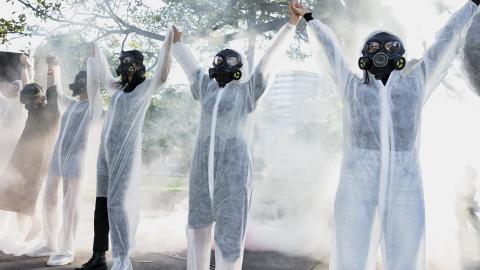
This rally in Melbourne was part of a coordinated, global series of rallies held to stand in solidarity with the Iranian people in their fight for human rights, as well as to condemn the chemical attacks on children at the hands of the Iranian dictatorship, which have gone unpunished.

In the past few months, poison attacks have affected hundreds of Iranian schoolgirls, prompting some parents to take their children out of school due to fear of what some have dubbed “biological terrorism.” 

These attacks started in November in Qom, which is the heartland of Shiite extremism and home to Iran’s Shiite seminary and Islamic institutions. This wave of toxic gas attacks has expanded to the rest of the country, but with thirty school attacks, the ultraconservative city of Qom still leads the list of the most-targeted cities. 

Speculation on the perpetrators of such attacks continues but the regime itself and regime-affiliated extremist groups are the main suspects. Some local media have said that it could be the work of religious zealots who want to prevent girls from attending school. Others, including former Vice President Mohammad Ali Abtahi, have speculated that the poisonings are the work of hardliners who want to “copy” the Taliban in Afghanistan and the militant Islamist group Boko Haram in Nigeria, which have banned women’s education and terrorized parents to stop sending their girls to school. Abtahi has asked in an Instagram post: “Has Boko Haram come to Iran?”

Several regime officials have highlighted the intentional nature of the serial poisoning of female students in Qom and other cities. Iran’s deputy education minister has admitted these attacks are “intentional” and Iran’s attorney general has acknowledged the poisoning of students in the city of Qom might be a “deliberate criminal act.” 

Yet, as in all other cases when things go wrong, Iran’s senior officials, including its president, Ebrahim Raisi, have blamed foreign enemies for schoolgirl poisonings.

These reportedly intentional biological attacks come at a critical time: the regime in Iran has been challenged by the death of Mahsa Jina Amini at the hands of Iran’s “morality police” on September 16, 2022, which sparked large protests across the nation. Consequently, it appears that the Iranian regime is taking revenge on this women-led movement by indiscriminately targeting schoolgirls.

A race between Sunni and Shiite extremists on misogyny

Iran remains the leading state sponsor of global terrorism. The Islamic regime brutally represses its own people and supports instability, chaos, and terrorist organizations abroad. 

As a predominantly Shiite country, Iran used to have sectarian animosity with such extremist groups like Al Qaeda. However, Iran has occasionally formed an anti-American alliance of convenience with Sunni terrorist organizations, hosting their leaders and providing them with logistical and financial support. The U.S. State Department stated in February that Said al-Adel, an Iran-based Egyptian, has become the head of Al Qaeda following the July 2022 death of Ayman al-Zawahiri. In addition, the former U.S. special representative for the reconciliation in Afghanistan, Zalmay Khalilzad, recently said that Iran has become a new center of Al Qaeda.

In addition to hosting, funding, and arming Sunni extremists, Iran also competes with these groups to make its Shiite version of Islam a more puritan, brutal, and misogynist brand. What Iran is doing with its schoolgirls is reminiscent of acts of such terrorist organizations as the Taliban, ISIS, Boko Haram, and Al Qaeda who oppose women’s education. Iran’s Shiite fanatics are competing with their Sunni rivals while the mullahs in Tehran deeply fear the progressive women’s movement that has adopted the “Woman, Life, Freedom” slogan, three components that go against the founding principles of this clerical regime. Thus, the government is adamant to clamp down and deter the women’s activism in Iran, even by means of poisoning them.

Silencing, stoning, enslaving, and taking revenge on the women is an inalienable part of Islamist extremist entities that despise women just for being women, especially if those women—like brave girls in Iran—dare to seek freedom from clerical tyranny, Islamist misogyny, and inhumane Sharia law. 

Putin’s mysterious poison game

Russian president Vladimir Putin has, on several occasions, used mysterious poisons and other biological and toxic substances to get rid of his enemies. He has also used these substances against schoolchildren. When Putin came to power in Russia in 1999, he started punishing the independence-seeking Chechen nation by indiscriminately bombing Chechen civilians, leveling the capital, Grozny, and targeting Chechen schoolgirls by collectively poisoning them by potentially using chemical agents or biological weapons.

When she was seventeen years ago, Anna Politkovskaya, a prominent Russian investigative journalist and human rights activist, started probing the poisoning cases of Chechen schoolgirls and began publishing her findings in 2006. She was found dead in her apartment a couple of months later. No one was charged for the murder as impunity reigns for perpetrators who go after anti-Putin activists. 

A similar pattern is repeating itself in Iran as the clerical regime is trying to collectively punish women by means of mass poisoning as there is no will to find and charge the perpetrators. Inspired by Putin’s poison game, Tehran has waged a war against schoolgirls by indiscriminately punishing brave Iranian women for resisting the regime’s efforts to subjugate and indoctrinate them.

Iran, Russia, and China

Iran has shown great interest in importing Russian and Chinese repression technologies, and it is possible that Iran has acquired its poisoning technology from Russia. 

Xi Jinping’s China is another source of inspiration for Iran. China is a dystopian, human rights nightmare as collective punishment can go as far as the mass rape and detention of the Uighur people, especially women in Muslim and Turkic-speaking Xinjiang province.

One can’t help but notice that misogyny is a common trait of all repressive regimes. Putin punished, in mass, Chechen women for giving birth to tough fighters who wanted independence from Russian tyranny. Xi is collectively punishing Uighur women for giving birth to a generation that wants to preserve their culture and tradition and defy the Chinese Communist Party’s indoctrination. Iran is indiscriminately punishing women and schoolgirls because of their leading role in anti-regime protests that started with Amini’s brutal death.

Iran, Russia, China, and other authoritarian regimes fear women the most. To deprive their nation of liberty, Putin’s Russia, Xi’s China, and clerical Iran along with Islamist terrorist organizations suppress women’s very existence.

What America can do 

While the women in Iran are putting their lives at risk and fighting for their emancipation and dignity, the democratic world led by the United States must take measures to ensure that they are on the side of the freedom-seeking women in Iran, not the regime. 

The Biden administration needs an effective and coercive strategy to address Iran’s nuclear and human rights dossiers; it cannot remain indifferent to Iran’s proliferation threat and human rights violations. 

Washington must act swiftly as the Iranian regime has enriched uranium to 84 percent purity, becoming closer than ever to weapons-grade material. At the same time, Tehran seeks sophisticated S-400 air defense systems from Russia which would make a potential Israeli airstrike on Iran’s nuclear facilities harder. The United States must take steps to ensure that Tehran will never access nuclear weapons to initiate an atomic Armageddon.

The free world should also be able to concur that the compulsory hijab is against women’s rights. Unlike what the Iranian regime and other radical Islamists say, the compulsory hijab is not part of the culture and national tradition in Iran or elsewhere in the Muslim world. The compulsory veil is a sign of submission and subjugation of women. That is one reason why Iranian women have symbolically been burning their headscarves during protests. To support Iranian women, Western diplomats must stop complying with this discriminatory and myogenic law when traveling to Iran. Recently, the Iranians were outraged by the Swiss ambassador’s decision to wear a long black veil during a visit to a shrine in Qom, the very city most affected by poisonous attacks against girls and women.

For the United States, devising a comprehensive strategy for targeting human rights abusers is indispensable. Designating those Iranian officials who are responsible for the biological war against women and are involved in the poisoning, killing, harming, denigrating, and subjugation of women in Iran should be a priority. The U.S. Department of the Treasury’s Office of Foreign Assets Control can do a better job of further sanctioning and including Iranian individuals and entities that are connected to women’s rights abuse in the Specially Designated Nationals and Blocked Persons list.

Read in the National Interest.

https://www.hudson.org/human-rights/gas-attacks-reveal-war-iranian-women

How to Curb the Threat of Iranian Drones


How to Curb the Threat of Iranian Drones

ahmad_hashemi

Ahmad Hashemi

Iran’s drone manufacturing enterprise has been long in the making. It started more than three decades ago during the war with Iraq in the ’80s. When the longest conventional conflict of the 20th century ended in 1988, Iran didn’t abandon its drone program.

After decades of steady development, Iranian drones are now battle-tested, relatively sophisticated, affordable, and conducive for mass production. Some even claim that Iran is emerging as a drone superpower and its drones are becoming a “game changer” in conflict zones.

Today, Iranian drones wreak havoc in the Middle East. Iran and its terror proxies use drones in Iraq, Syria, Israel, Yemen, Saudi Arabia, and the UAE to advance Iran’s expansionist foreign policy objectives.

Nor is the Iranian drone threat limited to the region. Iran-made drones pose a threat to Europe’s peace and stability, and Ukraine is a prime example of how Iranian drones can terrorize European citizens. The Iranian-made drones are gaining further significance for Russia’s war machine. They reinforce Russia’s position in Ukraine, as Russia’s weapons arsenal is depleted by the continuation of the war. Tehran is working on its plans to build a drone manufacturing facility in Russia to make at least 6,000 drones.

In addition, Iran’s drones and missiles pose a direct threat to U.S. air supremacy in the Arabian Gulf and the Middle East region. In an April 2021 testimony before the Senate Armed Services Committee, U.S. Central Command chief Gen. Kenneth McKenzie Jr. noted that the small and medium armed drones being proliferated by Iran and its proxies “present a new and complex threat to our forces and those of our partners and allies. For the first time since the Korean War, we are operating without complete air superiority.”

A senior Iranian Intelligence Ministry official claimed, in early February, that China is in the “queue” among 90 countries to receive 15,000 Iran-made drones, a claim that has not been confirmed by Beijing. There is no doubt that the global market for Iran’s drone industry is expanding, but as one of the world’s leading exporters of armed drones — that, among other countries, sells its UAVs to Saudi Arabia, the UAE, Myanmar, Iraq, Ethiopia, and even Iran — China does not need Iran’s inferior drones.

China has, in recent years, started flooding the Middle East with UAVs and, ironically enough, Beijing has exploited tensions between Saudi Arabia and Iran to supply both countries with its UAVs. China even struck a deal with Saudi Arabia in March of last year to build a drone factory in the Arab state.

In absence of a robust and credible deterrent, the Iranian regime is expected to further develop and proliferate its armed UAV technologies. But Washington can take a few simple steps to contain Iran’s drone program. First, do not help Iran by letting it gain control of U.S. drones. According to the 2019 U.S. Defense Intelligence Agency report, Iran has reverse-engineered many of its drone systems based on captured Western UAVs. When, in 2011, a malfunction led to a U.S. drone, RQ-170, landing in an Iranian desert, President Barack Obama reportedly decided not to take the risk of blowing it up before it fell into the hands of Iranian engineers intact. Within days, the Iranians paraded the drone through the streets of Tehran before starting their reverse-engineering mission. U.S. intelligence officials later concluded that the captured aircraft likely proved a bonanza for Iranian drone designers, who could reverse-engineer the craft. Cognizant of Iran’s reverse-engineering capability, Russia is even now sending some U.S.-provided weapons captured in Ukraine to Iran.

Second, the U.S. must stop selling drone parts to Iran.Despite years of sanctions against Iran’s defense sector, Iranian drones are still built largely with American and Western parts. Whether they are dual-use or have strict military use, the U.S. needs to prevent them from falling into Iran’s hands. Washington must aggressively sanction any Iranian entities and individuals involved in the drone program.

Third, the U.S. needs to give Ukraine training and weapons. America can exhaust Russia and defuse the Iranian-made drones in Ukraine by providing the Ukrainian forces with new weapons, advanced drones, fighter jets, and training to improve Ukraine’s chances of shooting down Iranian-made drones and targeting Russian sites where those drones are being prepared for launch.

Read in the Washington Examiner. 

https://www.hudson.org/defense-strategy/how-curb-threat-iranian-drones

06 March, 2023

Iran’s Weak Spot—Azerbaijanis—Serves Israel Well


Iran’s Weak Spot—Azerbaijanis—Serves Israel Well

Iran’s Weak Spot—Azerbaijanis—Serves Israel Well

As second-class citizens whose language is banned in public institutions, Iranian-Azerbaijanis seek autonomy from the Persian tyranny and consider Israel an ally in their struggle against the apartheid regime in Iran.

ahmad_hashemi

Ahmad Hashemi

Iran and Israel are at war and Israel’s extraordinary capacity to target Iran’s strategic assets is not news to Iran watchers. Iran has severely suffered from this shadow war.

Take the following examples: In the 2000s  Iran’s nuclear program was – according to foreign reports – severely compromised and delayed by Stuxnet, as the world’s first digital weapon. In 2018, in a daring and surreal move reminiscent of the James Bond movies, Mossad agents snuck tons of nuclear files out of Iran. In August 2020, Israel was accused of having its operatives kill Al-Qaida’s number two leader in the heart of Tehran. In November 2020, there was the assassination of the chief of Iran’s nuclear program in the Tehran suburbs, reportedly using an AI-assisted weapon. In July 2022, it was reported by foreign outlets that Mossad interrogated an Iranian IRGC member inside Iran.

And recently, on January 29, Israeli drones reportedly targeted Iran’s military facilities in Isfahan, a sensitive province in the heart of Iran, home to the country’s defense, missile, and nuclear industry.

Mossad operations along the Iranian border, reality, or fiction?

The Aras River serves as a border that has divided the Azerbaijani nation into two for the last two centuries: the Iranian Azerbaijan in the south and the independent Republic of Azerbaijan in the north. Since Azerbaijan’s independence in 1991, the northern side of the border has created new opportunities for the Jewish state. Azerbaijani President Ilham Aliyev once acknowledged that nine-tenths of Israel-Azerbaijan cooperation is below the surface. And with Prime Minister Benjamin Netanyahu in office, this strategic security partnership is expected to grow further.

After Azerbaijan liberated its territories from Armenian occupation in 2020, a new geopolitical landscape emerged. Azerbaijan now had a 428-mile shared border with Iran, an entirely unwelcome development for the regime in Tehran.

Iran has frequently warned about Israel’s military and intelligence presence in the Iran-Azerbaijan border areas. Yet, Azerbaijan has denied allowing Israel or other countries to use its airspace to carry out attacks on Iran’s nuclear and military sites. The Iranian foreign minister last year accused Israel of establishing a military presence and secret alliance with Azerbaijan. The Islamic Republic also believes that Israel’s theft of piles of Iran’s secret nuclear files in 2018 involved the use of Azerbaijan as a staging ground for that daring operation. More recently, some Iranian media claimed that Israeli drones flew, on January 29, from their bases in Azerbaijan to carry out attacks in Esfahan.

Parties may acknowledge or deny operations along the Iranian border but what is certain is that before, Iran was at war with Israel in the Levant by supporting Arab terrorist groups. Now, Iran feels that this shadow war has expanded to the Aras River.

Iranian Azerbaijanis, its Achilles’ heel

While Iran’s drones and missiles wreak havoc in the region and few neighboring countries are immune from Iran’s direct or proxy attacks, the clerical regime has so far avoided such direct military conflicts with Azerbaijan. Tehran fears that any military confrontation with Baku would provoke Iranian Azerbaijanis plus Turkey.

Tehran considers awakening Azerbaijani nationalism an existential threat to its territorial integrity. Iran is concerned about a powerful Azerbaijan and its spillover effects on Iranian Azerbaijanis, or South Azerbaijanis, as they prefer to call themselves. This explains why Iran wants to have a smaller border with Azerbaijan by supporting Armenian military presence in Azerbaijani territories, as Iran scholar Brenda Shaffer observed.

But the war in 2020 ended up having a totally opposite result, making Azerbaijan more powerful that now shares a longer border with Iran and the clerical regime now must worry about a stronger Israeli presence along its border with Azerbaijan, as well.

To make things worse, Iranian Azerbaijanis have favorable views of Israel, see the Jewish State as their friend, not enemy, and are willing to work with Israel to make Iran weaker. As second-class citizens whose language is banned in public institutions, Iranian-Azerbaijanis seek autonomy from the Persian tyranny and consider Israel an ally in their struggle against the apartheid regime in Iran. This fear of the country’s breakup deters the Iranian regime from attacking its smaller northern neighbor, Azerbaijan. Israel is aware of Iran’s weak spot and has sought to utilize that to its advantage.

Can Azerbaijan be part of Netanyahu’s crusade to stop nuclear Iran?

Netanyahu’s return to power set off alarm bells in Iran. Azerbaijan’s geographic proximity to Iran makes it a pivot state for Israeli intelligence-gathering and military operations. With only a 300-mile distance to Tehran, Azerbaijan has the closest international border to the clerical regime’s capital and some of its military facilities.

It is unlikely that Azerbaijan would greenlight Israel to use its territory for such strikes, but things are changing rapidly in the region. Geopolitical developments such as Azerbaijan’s decisive victory in the 2020 Karabakh War, Turkey’s growing influence in the region, the declining presence of sanctions-hit Iran, and Russia’s entanglement in Ukraine have all contributed to emboldening Azerbaijan.

As Tehran is getting closer to becoming a nuclear-threshold state, Azerbaijan’s geographic location, as well as Iran’s sizeable Azerbaijani population, are two important factors making the nation a valuable ally for Israel and the United States in countering Iran.

Azerbaijan might be willing to take the risk and become a launching point for a strike against Iran’s military sites, on the condition that it receives reassuring security guarantees from the West, namely the United States.

Read in Israel Hayom.

https://www.hudson.org/foreign-policy/iran-weak-spot-azerbaijanis-serves-israel-well

https://www.israelhayom.com/opinions/irans-weak-spot-serves-israel-well/